Feeds:
Posts
Comments

Archive for the ‘training’ Category

[tweetmeme source=”luau” only_single=false http://www.URL.com%5D

…and so it begins.

Today I ran 8 miles followed up by some strides. I followed my heart and ran happy.  The only real significance of the run is that it was the first scheduled run for this new training cycle. On Friday I officially signed up for the Around the Lake Marathon. Today I started the Pfitz 12/70 plan. The 12-week plan starts at about 55 miles per week and peaks at a little over 70.

So here I go again…

4 AM wake ups, predawn runs, long run Sundays. I’m looking forward to seeing if my legs can handle the new program. This will be uncharted territory for me in terms of mileage, but I think that it’s the logical next step.

Yes, here I go again…

Long runs, marathon-paced runs, tempo runs, VO2Max runs – my familiar morning friends.

Yes, here I go again…but fortunately for me, unlike David Coverdale, I may not be going “on my own”.  As you may or may not know, the Around the Lake Marathon is part of a greater 24 Hour Around the Lake Ultra Marathon. There is talk among the NERTS (the New England Running Tweeps) of forming a team to run the 24 hour ultramarathon as a relay.  They are still a few people short, so if you’re interested, let me know.  That relay team could/would serve as a pacer for the first 8 laps for yours truly! Talk about awesome!

In return, I’d crew for them the rest of the way.

Sounds like a party!

So here I go again…

It feel great to be running with purpose again, with a goal on the horizon.

Do you think David Coverdale was a marathon runner?

Bookmark and Share

Why do you run?

Read Full Post »

The Joy

[tweetmeme source=”luau” only_single=false http://www.URL.com%5D

With all the “what went wrong” and “what could I have done” and “what will I do” posts over the last two weeks, I was told in passing by my friend Brendan that I was analyzing my Boston Marathon race to death. The tone in his comment was not critical or even one of “hey, earth calling Luau” – it was simply matter of fact.

And he’s right.

Inadvertently, he reminded me that the running is not necessarily about the race or the analysis, but rather, it is about The Joy!

The benefits of the Runner’s High are well documented. So are the health benefits one gets from running; as are the psychological ones; and to a lesser degree, the intellectual ones.

What Brendan reminded me of is the joy of simply being active.  All of the benefits mentioned above come after a certain amount of time on your feet. To achieve them, you have to work – sometimes a little, sometimes a lot.

The Joy however is that feeling you get while you’re slipping on your shorts and then into your shoes, and then finally as you are stepping out the door.  That anticipation of movement, of sweat, of earned endorphins, of that feeling of “spentness”

I love that feeling – that sense of joy, that sense of knowing you are about to bring the pain and it is going to hurt so good.

I haven’t forgotten the Joy while I have been dissecting my 2011 Boston. In fact, the Joy has been, in part, what has kept me sane, allowing me to continue to have the desire to run despite the disappointment and analysis.

Well, after Brendan’s comment, the analysis is done, the disappointment is harnessed.

Yes, it is back to training; yes it’s back to numbers – The Around the Lake Marathon is less than 12 weeks away.  But this cycle is going to be about The Joy!

Bookmark and Share

Why do you run?

Read Full Post »

[tweetmeme source=”luau” only_single=false http://www.URL.com%5D

Yesterday I wrote about Discipline – how my lack of it at key times may have cost me my goal in my last marathon.

Our race day performances are, more times than not, a reflection of the training we have put in over the course of weeks and months.  My training cycle leading into Boston felt great.  My workouts were fast (for me).  Except for the recovery runs, they were all fast.  That isn’t a huge problem when you’re running tempo or VO2Max runs, but it is a problem when you are doing your medium-long and long runs.

There is a physiological purpose to the long, slow distance:

Pure endurance training stimulates [your ability to store glycogen and use fat for fuel] and increases the capillarization of your muscles…the primary type of training to stimulate these adaptations is runs of 90 minutes or longer…long runs are the bread and butter of  marathoners…the most beneficial intensity range for most of your long runs is 10 to 20 percent slower than your goal marathon race pace.  

-Advanced Marathoning by Pete Pfitzinger and Scott Douglas

My issue was that once I was out there on Sundays I would get sucked in by how good I felt.  Almost every time I was out on the road, I would realize early on that my splits were faster than the prescribed training.  My goal of a sub-3:15 marathon called for me to run the marathon at about a 7:24/mile pace.  According to Pfitzinger, I should have been running my long runs 10% – 20% slower than marathon pace.  That means I should have been running my long runs between 8:08 and 8:52 per mile pace.  It is at these speeds that the physiological changes occur to increase one’s endurance.  Looking back, my long run would start in the mid to low 8’s and ultimately end up in the mid to low 7’s.

Well, Luau, if you could run faster at those distances, isn’t that a good thing?

Here’s the thing – all those run simply proved was that I could run those distances (12 – 20 miles) at or near marathon pace.  They did not in fact do what the long run is designed to do, which is improve endurance.

So why didn’t you slow down?

That’s a damned good question.  Logically, that’s what I should have done.  I could see the splits on my watch.  I knew that I was running too fast.  But here’s the problem – I’m a mildly competitive person, not necessarily with others, but with myself.  I had a hard time slowing down.  Mentally I just couldn’t do it.

So what to do?

Obviously knowing my mile splits didn’t do it for me.  I felt good so I kept at the pace.  My legs didn’t feel like they were working too hard, and I was able to convince myself that if I felt good I could and should keep going.

I could fool my legs, I could fool my brain, but there is one part of the body I cannot fool – my heart.

One of the purest ways to determine how hard you are working is by listening to your heart.  The harder you work, the faster it beats.  It’s pretty simple.  When I trained under the Pfitzinger plans for both Smuttynose and Boston, I trained during the week solely based on time, or what I perceived my various levels (Recovery, General Aerobic, Long Run, Marathon Pace, Lactate Threshold and VO2Max) to be.  I determined my times based on past races.  The only problem is that some race results indicated that I could run a 3:07 marathon, while others indicated a 3:17.  10 minutes may not seem like a lot to a non-marathoner, but believe me, it is.

Guess which indicators I chose to believe?

As runners, we hear over and over again, train at the fitness level that you are at, NOT at the level you want to be.  Training where you are allows you to get better and improve; while training where you want to be, though exciting, can lead to undue injury and, possibly in my case, missing the point of certain runs all together.

So over the past week, I have dusted off the old heart monitor (I think it actually belongs to the wife), and decided I would let me heart lead my workouts.  Yes, I will literally allow my heart to dictate what the pace of the day (based on the prescribed workouts) will be.  So far, I have been pleasantly surprised to find that my heart rate remains relatively low when it comes to my Recovery and General Aerobic runs.  It may all be an indication that I was previously running too slow during the week and too fast over the weekends.

We shall see…stay tuned!

Now, if I could only get Garmin to send me the new Forerunner 610, I’d be all set!

Bookmark and Share

Why do you run?

Read Full Post »

Discipline is the bridge between goals and accomplishments

[tweetmeme source=”luau” only_single=false http://www.URL.com%5D

As I continue to peel back the layers of what may have happened to me at Boston, something keeps nagging me. Looking back at my splits, I realize that early on I wasn’t on pace for a 3:15 marathon, or even a 3:10. Some of my splits, had I been able to maintain them would have brought me in between a 3:00 and 3:05 marathon.

That’s a problem.

I’m not a 3:00 marathoner. Not yet anyway.

***

In retrospect, there were signs of the coming power bonk* during my training.

Throughout the winter, I was disciplined about running on the days I was scheduled. During the week I would run exactly or very near to what was prescribed by the Pfitz 18/55 plan I was following. On Saturdays, I would also run at the distance and speed that I perceived to be required.

But then there were Sundays.

Ah, the Sunday long run. It is, without question, my favorite part of training for a marathon. Whether it happens on my treadmill in the basement in front of the TV or, preferably, outdoors where I can enjoy the scenery, it is a relaxing time. Yes, I push myself; yes, I finish tired; yes, it is not easy; but it is peaceful. I get my highest runners’ highs off of the long run.

But there was a problem. I could never just run at the pace dictated by my training schedule. I always pushed the pace to a speed that was out of the physiological training zone I was supposed to be working on. Long, SLOW runs have their purpose. They are important, and yet I always pushed the pace a little faster than prescribed, probably costing me some precious endurance.

That being said, I was still probably in good enough shape to achieve the 3:15 I had originally been after, but true to form, when it came to race day, I pushed the pace. In the closing days leading up to Boston, I let myself get sucked into the concept of running a 3:10. My discipline went out the window at mile marker 1 and, in the words of my friend MK, the 20 – 25 seconds per mile I gained probably caused a classic bonk – and when I say classic, I mean an All. Out. Bonk.

I have never bonked like that before (not even at Manchester – that was my quads). I never want to bonk like that again.

So this training cycle is going to be about discipline (how I go about it I will discuss in my next post). Don’t get me wrong, I will still run happy. I will still have fun while I’m running. BUT, on Sundays and on race day, I will also remember the classic line, “slow and steady wins the race”.

More importantly, I will remember on race day that I have a plan, that I have trained for the plan, that I need the plan. I will resist the urge to push the pace early, and hopefully keep enough in the tank so that instead of hanging on for the final 10K, I will actually be able to pick up speed and finish strong. This was the strategy at Smuttynose, and it worked until I hit a soft wall with a mile to go. At that point though I just needed to finish to get my BQ…and I did.

So if you see me out there on a Sunday running way faster than I should, feel free to yell at me to rein it in. I know there are going to be times over the next 12 weeks that I just let the horses fly (or the schedule calls for a marathon-paced run), but I’ve got to remember, if I want to be disciplined on race day, I’ve got to do it in practice as well.

*In endurance sports, particularly cycling and running, hitting the wall or the bonk describes a condition caused by the depletion of glycogen stores in the liver and muscles, which manifests itself by precipitous fatigue and loss of energy.

Why do you run?

Read Full Post »

“Fear is the path to the dark side. Fear leads to anger. Anger leads to hate. Hate leads to suffering.”

-Yoda

“You have controlled your fear. Now, release your anger. Only your hatred can destroy me.”

“If you only knew the power of the Dark Side.”

-Darth Vader


[tweetmeme source=”luau” only_single=false http://www.URL.com%5D

Darth Vader, once the biggest bad-ass in the Universe, makes a compelling argument.  When we are angry, when we hate, we can harness a tremendous amount of strength and power.  Governments have been overthrown, wars have been won on the power of anger and hate.  But at what price?  I could go on endlessly on the topic, but this is a running blog, not a philosophy or history blog.

In the aftermath of Boston 2011, I found myself going through different stages.  Much like the path to the Dark Side, I first found myself fearing that I would never want to run a marathon again.  I then got angry that I let my game plan go out the window from the very start.  That was followed by a generic hateful feeling that ultimately led to internal suffering.  The anger part though has not totally faded away yet.  There has been a part of me that has been afraid that I will spend the next 13 weeks preparing for the Run Around the Lake by running angry.

Now, running angry can be productive.  It can get you over the hump, push you through the wall,get your ass out of bed -sometimes, to quote the movie Win-Win (which I highly recommend), you have to do whatever the f*@# it takes!

"whatever the f*@# it takes!"

…but, again, at what price?

If I train angry and run angry and accomplish my goal, what part of me will I have sacrificed to do so?  Will that anger instantly turn to joy if I run a sub-3:15?  Would I even feel joy as I cross the finish line with a sub-3:15?

Running is physically exhausting, with the return you get being a general sense of well-being for several hours after you run.  But anger is emotionally exhausting, negating that feel-good post-run feeling.

I feel like a young Luke Skywalker – new to the game, in possession of a mild amount of skill, with enough knowledge to think that I have enough knowledge, which of course, simply means I have enough knowledge to get myself into trouble.  As my dear friend MK pointed out in the comments of Complement, I’ve only been at this running thing for a little over two years – I am a beginner, a neophyte, a padawan.  I need patience tempered with the understanding that my endurance will come.

And yet, I hear the call of the Dark Side.  The taking running too seriously side.  The running angry side.  The running with hate side.  The running MTV-Generation Style side.

Doubtless, there will be days when I run with anger, but I hope I can follow the example of my friend Michelle, who preaches the concept of Running Happy.  I’ll get there, eventually.  I have to believe that.

To a large degree it’s just a matter of miles invested.  As long as I remember that, remember that each joyful step I take is one more step toward achieving my goal, I’m pretty sure I’ll be all right.

***

On Sunday I strapped on the old heart monitor and drove out to face those Newton Hills that shut me down just two weeks ago.  It was my first time running on them since the Boston Marathon.  My plan was to keep the heart rate low (as per my running schedule).  The run ended up being much faster than I anticipated, with my legs staying fresh, my lungs hardly having to work and my heart taking it easy.  It made me realize that I was not foolish to think that I could hit 3:10 at Boston, that sometimes, bad things just happen (whether by self-infliction or other means – based on MK’s comment, I may have simply gone out too hard).  April 18th just wasn’t my day.

July 29th will be…and I will do it with a smile on my face.

Bookmark and Share

Why do you run?

Read Full Post »

20110428-114814.jpg

com·ple·ment/ˈkämpləmənt/
Noun:A thing that completes or brings to perfection.
Verb:Add to (something) in a way that enhances or improves it; make perfect.

***

[tweetmeme source=”luau” only_single=false http://www.URL.com%5D

It’s time to complement – not to be confused with compliment.

No, though I’m sure I could write 1000’s of words complimenting all of you, today the topic is complement.

***

With every marathon that I’ve run, I have tried to follow a plan of some sort. For Manchester in 2009 it was the Runners’ World plan for Intermediate Runners. For Providence, and consequently Boston, last year (Spring 2010), I went with lots of long, slow, miles. For Smuttynose & New York (Fall of 2010) and Boston this year I followed my running bible, Advanced Marathoning.

In retrospect, I now believe I missed a very important part of the training process in each of these training cycles.

Yes, I put in the miles – man, did I put in the miles.

I ran fast.

I ran slow.

I ran hills.

I ran flats.

I.

Ran.

A lot!

See a “running” theme here? Despite mixing up the types of runs I was doing, I essentially did nothing other than run. Oh, I touched on doing push ups for a couple of weeks, planks for even fewer, but for the most part, every workout was about the run, run, run.

***

Now, my ego is still hurting a little from my collapse at Boston this year. Yes, I did manage to make Lemonade out of Lemons. I enjoyed myself immensely. But honestly, it is not the way I would have chosen to run this, or any marathon.

I’m not saying that my asthmatic episode was caused by a lack of core strength or lack of flexibility. I’m not looking for excuses. But I do know this – Pfitz’ 12/55 program call for 4 – 5 day of running per week. On the off days, the plan calls for either rest or cross-training. During the past two training cycles I have almost always chosen rest, and by “almost always” I mean always – an older guy like me needs recovery time, right?

Looking back I can’t help but wonder – would a stronger core have helped me expend less energy over the first 17 miles of Boston? would that conserved energy have translated into my breakdown happening much later in the race? would I have arrived at mile 17 just that much sooner? would increased flexibility have prevented the eventual tightening of my legs and shoulders after I went into survival mode? would I have been able to stride it out on the Newton Hills?

I don’t know the answer to any of these questions.  In fact, I’m starting to wonder if the episode was stress and anxiety induced.

However, I do know that every edge helps.

I went into Boston this year thinking that my legs were ready to run a 3:10. I still believe that they are, but I wonder if there are other parts of my running system that need a little extra work?

With that thought in mind, the next training cycle is going to be a little different from previous ones. I will still take rest days to be sure, but they will be significantly fewer and farther between.

There will be more stretching.

There will be more consistent core work.

There will be regular cross-training.

I’ve got 2 1/2 weeks to adapt to this new routine if I’m gonna run the marathon portion of the 24 Hours Around the Lake Race in late July. Hopefully, these complements will take my running up a notch and eventually take me to my goal.

…and then we can talk about compliments.

Bookmark and Share

Why do you run?

Read Full Post »

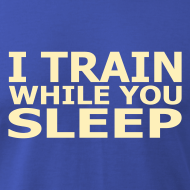
…but sometimes I sleep

[tweetmeme source=”luau” only_single=false http://www.URL.com%5D

When the alarm went off at 4:15AM this morning I rolled out of bed and headed to the bathroom to change in the dark.  2 days of predawn running and my body had already fallen back into the routine.

I wasn’t awake yet really.

My eyes were half-closed, my consciousness stuck somewhere in a fog.  As I slipped into my shorts, somewhere in the back of my mind I wondered why I hadn’t snapped to alert yet.  Usually by the time I’m walking out the bathroom and heading downstairs for some pre-run coffee, I am wide awake.

And then it hit me.  Last night was the third or fourth night in a row of getting just under 4 hours of sleep.

I like getting 6 hours of sleep a night.  In reality, I usually get 5 hours a night, which seems to work just fine.  But 4 hours a night?  Maybe for a couple of days, maybe even 3 nights a week, but not coming off of a vacation where I had gotten used to sleeping over 8 hour a night.

Sleep is an important part of any athlete’s regimen.  It is when our bodies heal and strengthen themselves.  It’s when we do most of our recovering, when our brains sort out the events and workouts of the day.  Without it, our bodies (and minds) would eventually break down.

And so, at that moment, I turned around, changed back into my sleeping attire, and caught another 75 minutes of sleep.

Fortunately, today was a scheduled off day anyway.

Bookmark and Share

Why do you run?

Read Full Post »

'Nuff Said

[tweetmeme source=”luau” only_single=false http://www.URL.com%5D

So after taking a week off from running, the alarm went off at 4:30AM this morning, telling me it was time to run again.  Time to dust off the shoes, slip on the shorts, put in some miles.

Honestly, I’ve had to force myself NOT to run since Boston.  It hasn’t been easy, but I think my body (and my mind and spirit for that matter) needed the time off.

Still, when the alarm went off this morning, a part of me just wanted to roll over and go back to sleep.  I had gotten used to not waking up so early just to pound out some miles.  As I’ve said many times, I am NOT a morning person.  I really am not.

But then I thought of a picture I saw (above) on someone’s dailymile page.   That was me, all winter.  Waking up between 4AM and 4:30AM, running between 5 to 20 miles.  And as much as I am not a morning person, I loved the feeling I would have for the rest of the day when I’d managed to drench myself in sweat before most people were waking up.

Now that school vacation is over, the days are going to get busy again – which made me think of this:

If I’m going to be good, I have to work around the busy-ness.

And it’s not about the competition with others…it’s about the competition within.

It’s about the desire to do better, last longer, run faster.

I leave you with a quote from a comment my friend M left me:

DISAPPOINTMENT IS THE HIGH WATER MARK OF EXPECTATION.

Bookmark and Share

Why do you run?

Read Full Post »

Next?

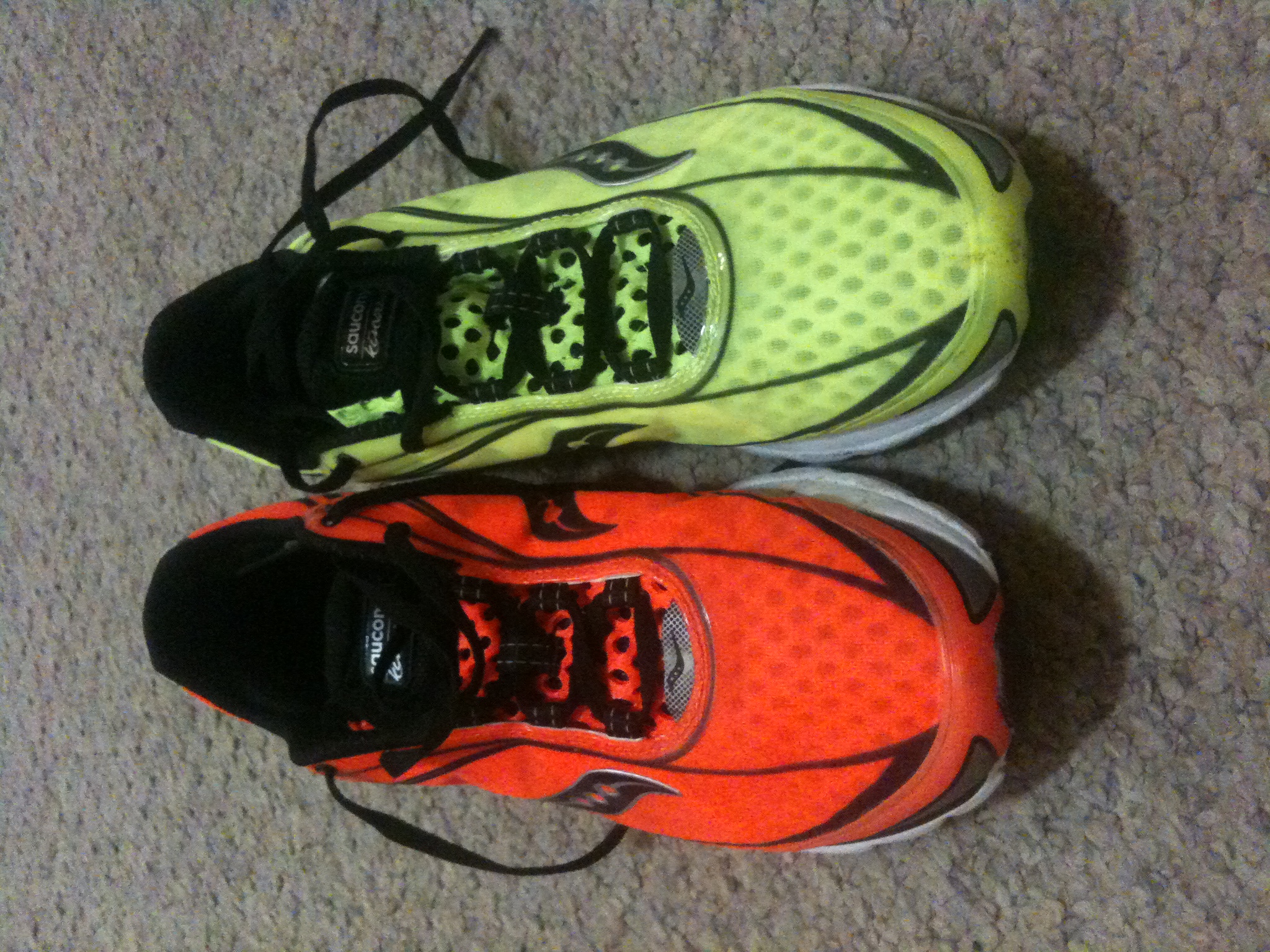
Where will these shoes be running next?

[tweetmeme source=”luau” only_single=false http://www.URL.com%5D

So…

Now what?

What’s next?

Damned good question.

Boston 2011 has come and gone.

A 3:10 Boston Marathon would have made it easy – the Vermont 50 in September followed by running the New York City Marathon with Autism Speaks in November with some shorter races between now and then.

But I think I have some re-evaluating to do over the next couple of months.  By late-May/early-June I need to make a decision of WHAT is it I am training for.  I have to decide what is more important to me this year – Is it scratching a 50-miler off the bucket list or is it taking one step closer to a sub-3:00 marathon? Can I do both?

A couple of things to consider:

  • The fall marathons I would be considering (a return to Smutty, maybe Bay State) don’t happen until AFTER registration for Boston 2012.  This means that my chances of getting into 2012 would still be based on my 3:19:19 from Smuttynose 2010.  Based on that performance, I will not be allowed to register until the 2nd week AND will have to hope that my 1:40 buffer is fast enough to squeak in.  The likelihood of there still being spots available for me will be pretty slim.  So, does it even make sense to attempt a 3:10 – 3:15 marathon in October.  To add insult to injury, even if I do manage a sub-3:15 but not a sub-3:10, I will be back in the same boat as I am now because of the lower time standards for Boston 2013.
  • If I run New York this year with Autism Speaks again, I will definitely approach it as a fun run.  I would probably still try to improve on last year’s time, but my approach would be completely different, with my first half being a lot more relaxed.  That being said, my New York Marathon strategy should not be hindered by a 50-mile trek in September.
  • I AM considering a small marathon at the end of July.  The 24-Hour Around the Lake Race has a BQ-Certified marathon built into it.  The marathon is 8 laps around Lake Quannapowitt in Wakefield, MA.  That’s pretty monotonous, but it’s also flat, like the elevation varies between 25 and 32 feet above sea level flat.  One other quirk is that it is run at 7PM at night.  That would be interesting and I think that as long as I didn’t get greedy, I could actually make a decent run at a sub-3:15 – that is, as long as the temperatures aren’t too crazy at 7 o’clock at night in late July.  A sub-3:15 here would put me in on the 5th day of Boston registration where I think I would have a better than 50-50 shot of getting in.  In addition, the pull of an early fall marathon taking me away from the Vermont 50 would disappear.

So…

Decision, decisions.

Bookmark and Share

Why do you run?

Read Full Post »

[tweetmeme source=”luau” only_single=false http://www.URL.com%5D

So this is it. The training aspect of my 2011 Boston Marathon is done.

This morning I ran an easy 4-miler. All that is left is 48 hours of rest and the 26.2 miles on Marathon Monday.

What will happen?

How will I do?

I don’t know.

It’s weird to think that the nearly 800 miles I have put in since mid-December all come down to one little stretch of road, taking me from Hopkinton to downtown Boston.

If you are running on Monday, may you run the race that you want to run.

Whatever the result, I will see you on the other side.

Bookmark and Share

Why do you run?

Read Full Post »

« Newer Posts - Older Posts »