Feeds:
Posts
Comments

Archive for the ‘training’ Category

Honey Water

[tweetmeme source=”luau” only_single=false http://www.URL.com]

Lately I’ve been hydrating and recovering with Nuun Water and mix1.  Both are great at what they do.  I love that the Nuun tablets make them completely portable.  I also find that after a tough workout, mix1 definitely feeds me the nutrients I need to be refreshed sooner.  Both are great for on-the-go athletes that need to throw something in the bag for a trip to the gym.

Unfortunately (or fortunately, depends on how you see it), the other day I was out of both Nuun tablets and mix1.  I was setting out for an easy paced 12 miler so I knew I needed something more than just plain water.  As I scoured the kitchen, hoping to find a stray tablet, I recalled what I had read in Born To Run about the Tarahumara drinking chia frescas, a combination of chia seeds, lime juice, honey and water.  It was said that this simple concoction kept these runners going for hours and hours.  Last summer I tried making chia frescas on my own, but had found that the chia seeds tended to clog the spout in my water bottles.  Nothing more frustrating that being 30 – 40 minutes into a run, squeezing your water bottle and getting nothing out of it.  My solution?  I took out the chia seeds and ended up with a citrus honey drink.  By the time Fall came around, I had simplified it even further by taking out the lime.  This simple honey water solution powered me to my 7 minute half marathon PR in November (1:33:14).

I’m not sure why I eventually moved away from the honey water.  Maybe it was because I ran out of honey one day or because my buddy Mike was recommending Nuun.  I don’t remember.  Regardless, but late winter I had switched to Nuun almost exclusively.

So the other day I was setting out for a 12 miler, and with no Nuun available, I went back to my old reliable.  What a pleasant “re-discovery”.   A nice side effect of drinking the honey water instead of the Nuun was that I didn’t need to pack any Gu’s either.  Taking a few sips of honey water every 10 – 20 minutes provided me the steady stream of simple carbohydrates I needed to maintain a consistent pace.  I also found that I was needing fewer gulps per mile .  I’m sure I’ll still mix in the Nuun regularly (you really can’t beat the convenience factor), but I have really enjoyed the honey water over the last four or five workouts.  This past Sunday I felt refreshed and able to continue after at 15 mile marathon paced run.  I’m still tinkering with the ratios, but a 5 – 10% solution seems to be working best for me.

Now if I could only get to hand out honey water at Smuttynose and New York, I’ll be all set!

Bookmark and Share

Read Full Post »

[tweetmeme source=”luau” only_single=false http://www.URL.com]

I’ve taken some time off to rest my knee.  In fact, when I resume my marathon training schedule on Wednesday with a medium long run (12 miles at a nice and easy pace), it will be my first run in exactly 2 weeks.  My original plan was to take 10 days off, but that meant starting yesterday with a 17 miler.  Felt a little much, so I decided to give myself one more day before resuming my schedule.  Fortunately (or unfortunately as the case may be) the schedule said that today and tomorrow were off days.  With 8 weeks to go I have the luck of coming back on a recovery week.  Nothing like a well-timed injury.

That said, I’m still a little nervous.  The knee feels pretty good, but I know that can change with one misstep, one tweak.  Maybe I need to face the fact that I’m not 20 anymore and that I can’t push myself as hard as, well, as hard as I wish I had pushed myself when I was younger. 

Isn’t it a shame that youth is wasted on the young?

Had I had the determination I have at 40 at the age of 20, who knows what kind of runner I might have become?  World-class?  Definitely not.  But could I have run a marathon with a 2:–:– handle?  Maybe…just maybe.

I am in better shape now than I have ever been in my life, save maybe when I was 16 or 17, when I was practicing kung-fu 2-4 hours a day, 6 days a week.  But being in the best shape of my life doesn’t change the fact that I’m 40 years old and I don’t bounce back as quickly as my mind and will would like.

Looking ahead at my schedule (I’m following the Pfitz 12/55 program from Advanced Marathoning), there are some interesting weeks coming up.  Some lactate threshold runs, some marathon pace runs and some VO2 Max runs – all sessions that produce a little extra pounding on the knee.  Running in VFF’s help reduce that pounding, but the fact that I’m still a heel-striker doesn’t help.  I’m actually toying with the idea of buying some shoes that may play to my heel-striking tendency – not to convert back to regular shoes, but just to mix it up.  My buddy Pete is pretty convinced that he has remained injury free in part because he mixes up what he puts on his feet from run to run.  There’s actually some science to that – maybe a topic for another post.

Where am I going with this?  I don’t know.  The heart and mind are determined, but the body is not as enthusiastic or resilient.  Is that enough?  Can it be enough?  I’ve only been running for 20 months.  Do more experienced runners go through this?  Or are they simply physically more gifted? How do they adjust?

The next couple of weeks will be telling.  I want to be able to complete the plan, knowing that if I do, and am healthy, I’ve got a pretty good shot at 3:20:59 at Smuttynose.  I have two friends, Brendan and the aforementioned Pete, who will be running it as well.  Brendan is shooting for 3:20 like me.  Pete, if all systems are go, may be shooting for a 3:15.  Running with those guys will be a big help to all three of us.  Like any daunting task, it’s much easier to tackle 26.2 miles with a group as opposed to alone.   The thing is, I can’t push myself to complete the plan and go into the Smuttynose hobbling – defeats the whole purpose of training, doesn’t it?  I do think I have to finally face the fact that I’m older now, so maybe it’s a little more important to stretch, do the warm up runs, do the cool down jogs and stretch afterward.

So I take my first steps back on Wednesday with a mix of anticipation and trepidation.  I’ll have to resist the urge to go all out, but also have to be careful not to run too conservatively.

When did I get old?

What’s your approach to training when coming back from an injury?  And for the older runners like me, has your approach changed with time?

Bookmark and Share

Read Full Post »

[tweetmeme source=”luau” only_single=false http://www.URL.com]

…when it comes to speed. What is fast for some is slow for others and visa-versa. Still, the one standard you can compare yourself to is, well, yourself. Part of the reason many of us enter footraces is to see just how fast we are. Once we have finished one, we use each subsequent race to measure how our speed has waxed or waned.  Much of our change in speed can be attributed to diet, hydration, training, weather and quality of sleep & recovery.

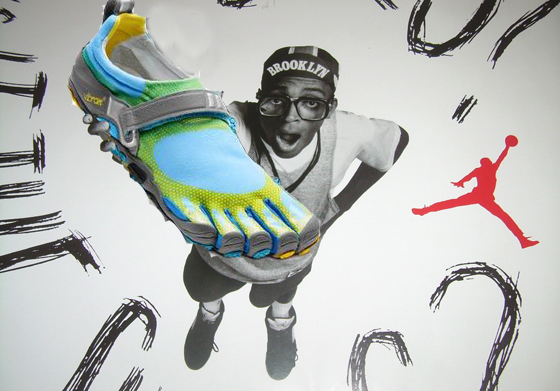
But what about Mars Blackmon’s eternal question, “Is it the shoes?”

Can what you wear on your feet make a significant impact on how you perform on the streets?  Nike, along with Blackmon (Spike Lee) and Michael Jordan, tried to sell us on that idea way back in the early 1990’s.  “It’s gotta be the shoes” was everywhere.

Runners today have a myriad of shoes to choose from when they enter a running store.  Every shoe has it’s selling point, whether it’s support or cushioning, firmness or flexibility.  And of course, we all have different feet, so the range of choice is a good thing, right?  But what if you are simply looking to increase your speed.  You feel you are close to whatever goal it is you have set for yourself, but you have fallen just a little bit short.  Is there a shoe for that?

People are constantly asking me, “Can you run fast in those, uh, things?” They point at my Vibram Bikilas or Treks, not sure what to make of them.

Commercial hype and celebrity endorsements aside (Joe Montana – it is so sad to see you pitching those Skechers Shape Ups), let’s do a simple thought experiment.  Let’s pit twin brothers against each other in a long distance race.  Each has had the exact same training, eaten the exact same foods, and received the exact same amount of sleep.  They are wearing the exact same outfits and weigh exactly the same.  They also both incorporate the same running style.  Which one would you bet on to win this race?  You can’t, because any bet you make would be a complete guess.

Now, let’s take one of the twins out of his traditional shoes and put him in a pair that weigh half as much (12oz to 6oz each).  This is now the only difference between the twins.  One is literally carrying 3/4 of a pound less than the other.  Now you may wonder, what difference can 3/4lb make in a footrace?  Well, based on certain calculators out there on the internet, for a 175lb man like me, it can mean 9 seconds in a 10K, 22 seconds in a half-marathon and as much as 45 seconds in a full marathon.  For a 150lb runner, the time difference is even greater.  What’s 9 seconds?  Well, it can mean the difference between placing in your age group  or not (I’ve missed placing in my age group twice 5 seconds or less).  It can also mean the difference between qualifying for Boston or not.  I still have over 9 minutes to make up, but if I ran in traditional shoes and clocked a 3:21:40, I’d be pretty ticked off!

So what am I getting at?  Vibram Fivefingers are my racing shoe.  They literally are half the weight of my old Brooks trainers and I am convinced that they have helped me reached times that I wouldn’t have had otherwise.  Between the  forcing me to run in a more efficient manner and allowing me to carry less weight, my speed has picked up.  At the age 40 and with only a little over a year of consistent running under my belt, I was able to record a sub-40 in just my second 10K.  I was not a runner before November 2008.  Was it solely because of the shoes?  No way!  But I don’t doubt that they had a huge part in my race that day (of course, I still missed the podium by a few seconds).

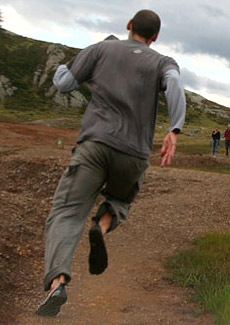
If you are a dyed-in-the-wool heel striker with no desire to change your stride, then the minimalist shoe is probably not for you.  But if you are naturally a mid- to fore-foot striker, or are like me, a partially reformed heel-striker, and you are looking for ways to cut down your times, the Vibrams, and more specifically the Bikilas or Treks, may be the shoe for you.  I’ve heard people say that as heel-strikers they cannot possibly run in the Vibrams.   I would have to disagree.  I have always been a heel-striker and although I’ve  tried to alter my mechanics, using a cross between chi-running and barefoot techniques, I will still land just ever so slightly on my heel.

Providence Marathon

Boston 13.1

Boston Run To Remember

That said, my heels have been fine.  I am a faster, stronger and more efficient runner than I ever was.

Taken to extremes, you may ask, well why not toss out the shoes altogether? Go barefoot!  That’s another 45 seconds right there!  The problem with that for me is I don’t have natural tread on the bottom of my feet.  Both the Treks and the Bikilas have enough tread so you can run hard and still maintain traction with the ground.  If I tried that barefoot, I think I’d rip the skin right off the bottoms of my feet.

I’ve put well over 1000 miles in VFF’s over the last 12 month, with close to 400 in either Treks or Bikilas, interspersed with some runs in my traditional Brooks.  I know my comfortable pace in my VFF’s is about 20 seconds faster than my Brooks.

Based on my personal experience therefore, I have to agree with Mars. “It’s gotta be the shoes!”

Bookmark and Share

Read Full Post »

Not Smart

[tweetmeme source=”luau” only_single=false http://www.URL.com]

So yesterday I tackled the first workout of my 12 week plan leading up to the Smuttynose Marathon. On tap: an 8 mile aerobic run (somewhere between a 8:45 – 9:15 per mile pace) followed by 10 x 100 meter strides. Sounded easy enough. Shoot, I’ve been doing 10 and 11 milers regularly lately between 8:00 and 8:27 per mile pace.

I was eager to get started. I truly believe if I can follow Peter Pfitzinger’s plan, I’ll have a good shot at 3:20. So after I fed the kiddies, packed Brooke her lunch for camp, sent the wife and Katie off to a water park, cleaned the kitchen and did the laundry, I was ready to get running. It was 11:50 when my feet hit the pavement. My plan was to finish my 8 by 1:05, get my strides in and be back home by 1:30.

***
24 hours earlier

Katie was finally getting over a fast working virus that knocked her out of commission on Saturday and Sunday. Now my head was starting to pound. It spread from my temples to my eyes. I was having trouble focusing. Soon the nausea hit. Katie had thrown up twice and I feared it would shortly be my turn. Although I managed to avoid praying to the porcelain god, I did end up spending the next 18 hours in bed. I drank little and ate even less.

***
As I ran past the first half mile mark, I realized I was going too fast for what this run called for. I tried slowing it down a bit. The first three miles were an interesting struggle of the mind calling for a slower pace and the legs pushing for a faster one.

But at the end of those three miles however, the struggle had flipped. Suddenly my breathing became labored and the legs dragged. This was supposed to be an easy run, but it was quickly turning into a battle. The temperature continued to rise, 84°, 86°, 87°. The humidity wasn’t helping.

I considered calling it a day, but I thought of the post I had just written about Heart and the fact that this was the first workout of the program, and so I trudged on. I thought about the marathon pace long run scheduled this Sunday and I wondered how could I possibly do that. I was ready to quit.

But this was day 1. I couldn’t quit on day 1. I struggled on. From mile 6 on, I had to stop and walk for 30 seconds to a minute after every half mile. After arriving at the track at 7.5 miles, I stumbled through one lap and had to stop. My easy 8 miler had turned into a brutal, oppressive 7.75 miler.

I drank the last of my nuun water and stared at the other end of the football field 100 yards away. I needed to do 10 of these?

I felt woozy. I glanced over at 3 kids, recent graduates from the local high school, running a hurdles drill.

“Do you know where a drinking fountain is,” I asked.

One of the boys answered that there wasn’t one but they could give me some water. They filled my bottle half way up as I thanked them. It was all I could do not to sit on the ground, but I was afraid if I sat down, I wasn’t getting back up.

Another wave of nausea and the ground started to spin. I straightened myself out, but the ground continued to tilt. Suddenly with every blink came black spots. I gulped down the water, hoping it would help hold the world still.

The ground stopped moving, but it didn’t feel steady. The spots didn’t go away for several minutes. I focused on the conversation I was having, trying to breathe normally. Another spin, another wave.

I suddenly had a vision of these three kids making the front page of the local paper because they had rescued some poor old, passed out, aspiring marathoner from his own stupidity.

I again straightened up, thanked the boys, and proceeded to stumble home, skipping the strides. When I weighed myself at home, I was nearly 5lbs lighter than when I had left for my run. This despite having drunk a bottle and a half of water and a bottle of mix1 recovery drink. I had obviously been sweating – a lot!

It took me the rest of the day and part of the evening to get back to feeling normal.

So why am I writing about this awful experience? What’s the point?

I should have waited until today to run. Aside from the marathon itself, schedules are not set in stone. If you’ve been sick, and not consuming liquids or calories, maybe it’s best to take the next day off.  Don’t be stupid like I was yesterday just because you can’t wait to get started.  If it hadn’t been for those boys at the track, I may well could have ended up passed out cold in the middle of the football field.

Hopefully the 9 miler tomorrow won’t be such a struggle.

Bookmark and Share

Read Full Post »

Heart

[tweetmeme source=”luau” only_single=false http://www.URL.com]

Last week, a little over 12 weeks out from my next marathon, I suddenly had a crisis of confidence.

It’s not like I fear the marathon like I used to.  I know I am capable of finishing.  Yes, there is always a part of me that wonders “can I finish this marathon today” but for the most part, I know that if the fate of the world depended on me running 26.2 miles in one shot, I could do it, and the planet would be saved.

No, the crisis wasn’t about completing a marathon.

It was about finishing, more specifically, finishing strong.

***

I am close.

Real close.

Just over 9 minutes close to calling myself a Boston qualifier (3:20:59).  Yet many of the metrics used to project marathon times based on shorter races like the half-marathon and 10K indicate that I should be capable of running anywhere between a 3:07 and a 3:17.  My best to date?  A 3:30.

So what’s the problem?

I supposed I could reason that Boston is a tough race to qualify with.  I could argue that maybe I would have BQ’d in Providence had I not just run a Boston 2 weeks earlier.

But those would just be excuses.

Is Boston really 12 minutes harder?  Did running Boston really cost me 9 1/2 minutes in Providence?  I have a hard time believing that.

***

Many in my life will attest that I have struggled through much of my adult life with the concept of finishing.  I will start dozens of projects and finish a few.  One of the “few” things that I have maintained an almost laser-like focus on has been running.

Running has brought a certain amount of order to my life that was definitely lacking before.  With each race I have signed up for, I have been able to focus on a goal and follow it through.  The success or failure in achieving that goal (a sub-40 10K – SUCCESS!, a 1:30 half-marathon and a 3:20 mary – not yet) has almost been secondary to following the task to the finish line.

When I briefly ran cross-country in high school, I did it begrudgingly.  I ran because I really wasn’t any good at any other fall sport.  Unfortunately, I was expected to do something in the fall to stay fit for the spring track season (I ran the 330 IM hurdles – I was too slow for the 100, 220 and 440).  To say I didn’t like it is an understatement, plus, I really wasn’t any good.  I dropped out of a few races, a few because of injury, others because my heart was just not in it.

***

My heart was just not in it.

***

That statement has been floating around my head for the last few days.

Is that my problem?  Is it a heart issue?  A twitter friend said to me recently that she thought that heart was represented through determination.  I’m pretty sure that I have that.  Another friend said to me when I first started this marathon quest, that the last 6.2 miles of a marathon are where you really discover just who you are and what you are made of. The last 6.2 of Manchester showed me that I could finish what I had started, even if it meant doing so on frozen quads.  But as I look back at Boston and Providence through the lens of time, I wonder, what did those last 6.2 miles really tell me?  Did my body fail me, albeit to a lesser degree, again? did I error strategically? or was it my heart?

I am going to tell myself it was the first two, and I now have 12 weeks to prove it.  For my Boston/Providence double this Spring, I did not follow any particular training plan.  I simply ran.  I logged a tremendous amount of miles, but never followed any schedule, and quite honestly, never did much in the way of speed or threshold work.  That changes for this fall.

Yes, I am again pulling a double (this time 5 weeks apart), but my approach is going to be different.  I am running the Smuttynose Rockfest Marathon on October 3rd followed by New York City in November.

For the next 12 weeks I will be following a plan (the Pfitz 12/55) that works on endurance, speed and strategy.  Something I have come to realize, just now, is that race day strategy doesn’t start when the gun goes off.  It starts with the beginning of your training cycle.  I tried to execute a smart strategy in Boston on race day, but the training I had done (essentially all long runs) didn’t lend itself to doing that.

The training isn’t going to be easy.  There will be hard runs and easy runs over the next 12 weeks, but maybe that is what heart is all about.

To go back to my twitter friend, determination is where it all starts.  It’s time to train hard, and more importantly, train smart.

I’ve got 12 weeks to make my body match my heart.

My heart is set on 3:20.

Bookmark and Share

Read Full Post »

[tweetmeme source=”luau” only_single=false http://www.URL.com]

…the Need for Speed.

The primary training tool in the marathoner’s tool box is mileage. The more miles you put in the bank, the more likely you will be able to successfully complete a marathon. Logging 60 miles a week (something I’ve never done) will force your body to adjust to the concept of 26.2 miles much more aggressively than running 20 miles a week. That’s not to say that you can’t complete a marathon on 20 miles per week training, it’s just makes the task a bit more painful.

That said, my goal really has never been to just complete a marathon.  Don’t get me wrong.  Completing a marathon is huge.  HUGE!  But from the very start, I wanted to eventually be able to call myself a Boston Qualifier.   As much as I have improved over the past 8 months, dropping 24 minutes on my marathon time, I am still 9 minutes and 12 seconds short of accomplishing that goal.

As banged up as I was at the end of both Boston and Providence, my legs recovered quickly and I was upright and walking down stairs within a day.  Fitness is not the issue.

Speed is.

I have a need and the need is speed.  At both Boston, but especially at Providence, I had opportunities late in the game to pick up the pace and finish close to 3:20.  As much as I tried, the speed just wasn’t there at the end.  I never stopped running, but in both cases, the last three miles proved to be my undoing.

Enter Yasso & Galloway.

My hopes are that this fall, Bart Yasso and Jeff Galloway will take me to the promised land.

Both are running experts and both have “discovered” certain indicators that can tell you if you are ready and able to hit your desired marathon time.

I plan on using their methods as part of my speed training this summer to help me get to where I want to be.

You can find their indicators here & here, but in a nutshell they work as follows:

Yasso 800’s: Once a week you go to the track and run a series of 800 meter intervals.  Starting with 4 intervals and adding one each week, you try to run each 800 in minutes and seconds in the time that you would like to run your marathon in hours and minutes.  I would like to run a 3 hour 20 minute marathon or better, so I will run 800 meter intervals in 3 minutes and 20 seconds or less.  In between each interval you walk the same amount of time.  Eventually you build up to 10 intervals, and if you can do that, you should be ready to run your marathon.

Galloway’s Magic Mile: Once every 2 weeks or so, you run a mile about as hard as you can.  Galloway says that at the end of the measured mile you shouldn’t be able to maintain that pace for more than another 100 yards, though he does emphasize no puking.  Over the course of you training, you do 4 magic miles, eliminate the slowest, and average the remaining 3.  From there he has a program that calculates what your magic mile average indicates.  I need to average a 5:53 mile or better to run a 3:20 marathon.

The indicators alone won’t be enough speed work by themselves, so I plan on throwing in some shorter intervals along the way (some 400’s and 200’s).  If you have any suggestions, please let me know.  My goal this summer is to do Yasso 800’s once a week, running 3:20 splits or better and check my Magic Mile at least 3 times.  Hopefully come October (I’m looking at the Smuttynose Marathon on October 3rd) both of those indicators will tell me that I am more than ready to break the 3:20 barrier in the marathon.

Stay tuned!

Bookmark and Share

Read Full Post »

Drive

If we can’t live together, we’re gonna die alone.

-Jack Shephard


[tweetmeme source=”luau” only_single=false http://www.URL.com]

What am I running from?

What am I running to?

What drives me?

Is it as simple as that?

A few weeks ago I was having a conversation about the relationship between self-image and food. The gist of that particular conversation was that some people use food to fill a void or ease a pain in their lives.  The void or pain “drives” them to food.

Not a revelation, I know.

But for some people, they need to hear it out loud or from an “expert” to internalize it and then use that information in a positive way.

That conversation got me thinking about my relationship with running.  Without a doubt there are some who have substituted running for food in the above mentioned relationship.  I don’t think that it’s a lot of people, but it’s a reality.   I had to ask myself, what about MY relationship with running?

Is there a void? And am I trying to fill it with miles upon endless miles? Is there a buried pain that I am not aware of (or choose not to be aware of) on the surface?

I consider myself a pretty shallow guy. I don’t mean that in a negative sense. I mean that for the most part, when it comes to me, what you see is what you get. There are a few deep undercurrents, but I am generally an open book and am pretty easy to read. At least that’s what I believe.

So what drives me? Why do I do this? Why get up early or go to bed late to run.

A long time ago I had a huge competitive streak. I worked hard to be first in everything I did, whether it was in academics, on the track, or in the ring. I wasn’t always the best, and sometimes I had my ass handed to me with a side of humble pie, but I always came at it hard.

Somewhere along the way, I lost my edge…completely. So when I discovered running 18 months ago, and found that one could be competitive no matter the talent level, my fire was somewhat renewed.

I love running because, despite the fact that 99% of us will never win a race outright, we can feed our competitive fire with the runners that are around us. Whether you’re fighting for 10th, 100th or 1000th place, you can still fight, push, give 100% and feel good about how you did. Disappointing finishes can be used to fuel the fire and drive you.  A fantastic finish can feed your desire even more.  In the end you are truly only racing against one person – yourself.

That is what has driven me in my runs for the last 18 months.  Trying to PR with every race, trying to push myself harder and faster than I did before.

But this past week brought me a completely different kind of fuel.  One that can be just as powerful, if not more so, than the re-kindled internal flame that has been driving me.  This summer I am running for my girls.  One of my two daughters is on the autism spectrum, the other is typically developing, but both are greatly affected by the effects of autism.  Though my little one is the one who struggles daily with autism, my older one has had to learn how to accommodate a little sister who can act in ways that don’t always make sense, are sometimes irrational, and quite frankly, from my older one’s perspective, occasionally embarrassing.

Though her struggle is nothing like that of my little Brooke’s, Katie’s struggles are nonetheless real and truly burdensome.  Katie, in a lot of ways, has had to grow up more rapidly than her peers.  She tries to find a balance between being a typical 9-year-old girl and being the big sister of a 7-year-old with autism.  I have to remind her on a regular basis that she does not need to “mother” her sister.

But there is a third girl in my family who has been deeply affected by autism as well – the Wife.  She has had to take a different path than I am sure she imagined when we first said, “I do” (coincidentally, this past Sunday was our 11th anniversary).  Having carried both our girls for 9 months,  she has felt every bit of pain and frustration she sees in both Brooke and Katie in ways that cut deep and leave scars. She has found her outlets through her blog and has become a uniter of sorts in the local community, helping create a very popular inclusion committee at the girls’ elementary school.  But she too, along with Brooke and Katie, struggles with the rippling effects of autism on a daily, if not hourly, basis.

When I first got word from Autism Speaks that I had been accepted to be part of their team for the 2010 ING New York City Marathon, I focused almost completely on my little Brooke.  I sent out emails and updates on Twitter, Dailymile and Facebook asking people to help me help my little girl Brooke, but the more I thought about it, the more I realized that this run, these efforts by Autism Speaks, my reason for asking you for donations and/or spreading the word, were less about just Brooke and more about the big picture – the families and circle of friends that are affected by weight of autism.

Autism can be isolating, not just for the person affected by it, but for the entire family.  From a personal perspective, I can tell you that autism, although introducing us to a whole new world of friends (Drama, Jersey, Judith, Pixie, Jeneil?  We love you!), it has also kept or pushed us to the periphery with other groups.  I don’t blame those people who have fallen off our social radar.  Part of it has been our own doing.  Some people just don’t get it or are unable to convey and instill their own compassion into their children and because of that we have withdrawn.  But sometimes, it is the other families that pull away, because it is the parents who can’t wrap their brains around what it is we go through on a daily basis.  Again, I don’t blame them.  It’s human nature to pull away from something we can’t understand.  Hopefully awareness can change some of that.

And so I run this summer.  I run for Autism Speaks.  I run to raise autism awareness.  I run to make the world a friendlier place for my Brooke.  I run to make the world less of a burden for my Katie.  I run to help the wife see a world where the sun is in fact shining, there are fewer tears, and the occasional torrential rain storm can be a good thing because it can lead to rapid  growth.  I run to help others, whether they are affected by autism or not, to reach across their differences and shake hands in friendship.  In the end, whether it is autism, some other disorder, religion, politics or whatever it is that divides us,  if we can learn to appreciate and understand our differences, we can learn to live and thrive together.

Yes, I have found a new fuel to drive me this summer – it starts with my three girls, Brooke, Katie and the Wife.

Brooke, the Wife & Katie

I hope you will join me in my fight.

Click —>HERE<— to link to my Autism Speaks donor page OR THERE—> Bookmark and Share to help me spread the word.

Read Full Post »

Annie

[tweetmeme source=”luau” only_single=false http://www.URL.com]

I used to love tomorrow.

Tomorrow offered the promise of a new day. The sun was sure to shine tomorrow. Tomorrow would clear away the cobwebs and the sorrow.

But there’s a problem with tomorrow. Something that I’ve grown to really dislike about tomorrow.

As the little red-head sings, it’s always a day away.

Tomorrow never comes and never will…especially when it comes to something like finding the motivation to run. If you are going to wait until tomorrow to start running, don’t bother – it ain’t gonna happen.  I’ve seen it too many times among friend, acquaintances, but more specifically, me.

“Oh, I’ll start that running program tomorrow.”

“I am gonna start running next week on Monday.”

“I got sidetracked today [Monday] so I guess I’ll have to start next week.”

“I’ll get to those Yasso 800’s.”

NO!  No, you won’t. You won’t do it unless you start today!  Right now.  If you’re not going to do it today, at least make a schedule and write it in.  Not in pencil.  Do it in permanent marker and write it down.   Carve out the time.  And then commit.  And no more excuses.   Just do it.

Time marches on, days go by, the body ages – but tomorrow will always be a day away.

Go!

Run!

Today!

Bookmark and Share

Read Full Post »

[tweetmeme source=”luau” only_single=false http://www.URL.com]

So this Sunday I am running the Boston Run To Remember Half Marathon. It will be my second time running it and my third half marathon overall. So far, in my short racing career, every race has produced a PR. 8 races, 8 PR’s. Granted, some of those PR’s were because I was running a particular distance for the first time.

I am afraid that the streak will come to an end this Sunday. In order to keep the streak alive, I need to run a 1:33:13 or better. If you had asked me last week whether I thought that was achievable, I would have bravely answered in the affirmative, however, now that I have a few runs under my belt since taking two weeks off, I am a little more doubtful.

As wonderful as it has been to be back on the road and running, I have definitely noticed a drop in efficiency. It is taking more energy to go the same distance and despite working hard to maintain cardio health through the elliptical and swimming, the combination of  two weeks of rehab and a four week taper (see Boston and Providence) may have proven to be too much.  I have read that it takes four weeks for a well conditioned runner to lose their fitness level.  Unfortunately for me, I feel like I may be 2 weeks over.

Running this week has felt great mentally, but has been a grind physically.  Even today’s 5 miler was hard to get through.  The wife asked me earlier this week if I was still planning on running this Sunday.  I nearly scoffed at her saying, “of course I’m going to run!”

But she had a point.

Maybe it isn’t so wise to jump right back into a longer distance after taking some time off.  After a 20 mile race and 2 marathons over the course of 5 weeks, I convinced myself that a half-marathon was a short distance.

It’s not.

Bottom line for me is that I will make how I run on Sunday a race time decision, and then continue to make adjustments throughout the race.  If there is nothing else that running has taught me, it’s to do a self-check every few miles or so, no matter what kind of physical condition you’re in.

Before I went out for my run this afternoon, I told myself that instead of shooting for a PR this weekend, maybe I should be aiming for an RR (Race Record).  Last year I ran a respectable 1:40:47 (though it turned out someone took a wrong turn and the course ended up being 12.95 miles).  If I beat that, if I could keep a 1:3-:– handle, I’d be pretty happy.

But after today’s run, a tough 5 miles in what felt like tremendous heat, I’m feeling like I’ll be lucky if I finish.

It all comes down to efficiency.  How efficient is my body with the energy stores it has?

This Sunday, we’re gonna find out.

Bookmark and Share

Read Full Post »

[tweetmeme source=”luau” only_single=false http://www.URL.com]

I’d like to think that I’m in pretty good shape for a 40 year old. In fact, I would argue that I’m in better shape now at 40 than I was at 20.  I feel I owe a large part of that to running.  I wasn’t in bad shape when I started running 18 months ago, but I certainly wasn’t in the shape I am now.  As soon as I started running regularly (25 – 35 miles per week) nearly 30 lbs and a 5% body fat disappeared like magic.

As great as running has been though, it does beat up the body, especially if you run 2 marathons in 2 weeks.

After  the Providence marathon my legs were worn out, particularly my right knee.   So I took 2 weeks and self-rehabbed by laying off the running.  I tried to keep up my cardio health by hopping on the elliptical or swimming laps, and I think I pretty much succeeded.  That said, I noticed both in the mirror and on the scale, that I was getting a little soft around the edges. It wasn’t a lot, and I’m pretty sure nobody noticed but me.  I was a little surprised in that I felt that I was doing a pretty good job of maintaining activity and effort.  Still, the scale over those two weeks jumped 10 pounds, so I was obviously not working as hard.

This week I started running again.  On Monday I went out for an easy 7 miler and on Wednesday I went out for a hard 5 miler in 92° heat.  Nothing unusual about that, I know.  But this is where I become ever more convinced of the tremendous power of running.  Since Monday, half the weight gain has disappeared and when I looked in the mirror this morning when I got up, the figure I saw standing before me was a lot more focused.  The softness was gone.  2 days of running and I can feel and see the difference.

That’s the power of running.

I know that swimming is supposed to be the best overall exercise for your body and that the elliptical is supposed to be much better for your knees, but I am more convinced than ever that the closest thing to a miracle pill is running.

It just works.

Bookmark and Share

Read Full Post »

« Newer Posts - Older Posts »