Feeds:
Posts
Comments

Archive for the ‘training’ Category

[tweetmeme source=”luau” only_single=false http://www.URL.com]

After nearly 2 years, I have finally reached a balance when it comes to my funny little running shoes. As many of you know, I have been a proponent of the Vibram Five Finger shoe for almost a year and a half now. Part of my inspiration came from reading Born To Run by Christopher McDougall, part of it came from my good friend Mike (famous for his battle with the Cat in the Hat last April). The thing is, you may have noticed that I haven’t been talking about them quite as much lately. I haven’t been pushing them, proselytizing about them.

I realized recently that I went into this minimalist shoe thing, the VFF’s in particular, all wrong. I did everything one was NOT supposed to do, and I paid for it with pain, injury and worst of all, time away from running. If transitioned to properly, I believe that the Vibrams are one of the best things you can do for yourself, your feet and your running, on many different levels.

Let’s start with why they are good:

  1. They will push you to run with proper form – the thing about running barefoot is that you can’t be a heavy-duty heel striker. Even if that is what you have become, you are forced by the lack of heel protection to change your posture. If you try to continue to run with a heel-strike while barefoot, you’ll only end up hurting yourself…badly.
  2. If used properly, you will avoid injuries to your knees and hips – because you are forced into better posture, your knees and hips don’t take the extreme pounding they would normally take while running with a heel-strike
  3. You will run faster – because you are not hitting the breaks with your heels at every footfall, your momentum doesn’t get interrupted and you are able to maintain a higher speed.
  4. You will run longer – because of the maintained momentum, you expend less energy with each step, each yard, each mile, leaving you more energy to run farther.

Sounds pretty good. Sounds like a miracle shoe. Let’s go out and get a pair and start piling on the miles!

***

***

Yeah, you know what? That’s exactly what I did. I read Born to Run and I talked to my buddy Mike and I was sold, convinced, converted. I was ready to dedicate my feet to Barefoot Ted and Vibrams. So I went out and bought a pair of the VFF Sprints, took them home, hopped on the treadmill and ran 3 miles.

BANG! BANG! BANG!

That was the sound of my feet on my treadmill as I ran my first VFF run. It was so loud! But you know what? It felt great…for about half a mile. Then my shins started to hurt a little. The burning pain grew, but I was determined to keep going.

These were Vibram Five Fingers!

They were barefoot shoes!

Evolution had programmed and designed me to run like this.

The pain would go away, right?

RIGHT?

But no, the pain didn’t go away. In fact, it got worse. By the time I hit 2 miles my shins were throbbing and my calves were starting to bark.

I breathed a sigh of relief when I finally hit 3 miles.

MY GOD THAT WAS PAINFUL!!!

But the pain was nothing compared to what I felt the next morning.

You know that feeling you get the morning after a hard fought marathon? The kind of feeling that forces you to walk down stairs backwards? Yeah, well 3 miles in the Vibrams on the treadmill had pretty much done the same thing to me. For the next three or four days I hobbled, if you could even call it that. Walking was painful.

In all seriousness, I was ready to toss the shoes and call them an $80 mistake. I called my buddy Mike to bitch about them, but before I could say anything he asked how far I had run in them.

“3 miles,” I said.

There was a moment of silence on the other side of the line and then some mild laughter. He knew. He knew that I must have been in incredible pain.

“Dude! You shouldn’t have done more than a half a mile the first time in those things! You could really hurt yourself like that!”

“Well, you could’ve told me,” I said. He laughed and we moved on to other topics, but at that point I realized that I needed to give the Vibrams another chance. This time I would take it slowly and build up my mileage a little at a time.

And that’s what I did. Over the course of the next month or so, I built up my mileage until I was able to do 8 mile runs regularly in them.

This is where my next big mistake came. I loved these shoes so much, that I eliminated my other running shoes completely. I loved them and talked about them so much that my wife had this made for my birthday:


Yes, that is a Vibram Five Finger KSO Cake

The problem with that is when you wear the same shoe all of the time, you run a higher risk of repetitive motion injuries, and when you’ve spent a lifetime running in regular shoes, certain muscles and tendons have atrophied to the point where they are weak and brittle. I got away with it for a few months. I had developed a pretty decent stride, but my form still had a tendency to break down a little late in longer runs. I was able to fend off injury to my achilles’ tendon through stretching, but in the meantime, I didn’t realize what I was doing to the tendons on the top of my feet. About 5 weeks before I was to run my first marathon, I went out for a run and I got a sharp pain on the top of my right foot. This was not a “let me see if I can run through it” type of a pain. No, this was, “HOLY CRAP I HAVE GOT TO STOP RIGHT NOW!!!” kind of a pain. Being the intelligent person that I am I decided to try another 10 yards and nearly collapsed to the ground on the second stride.

Something was dreadfully wrong.

After much testing and worrying, I was relieved to know I had not broken anything. I had a severe case of tendinitis however and the doctor ordered me to lay off the running for six weeks.

Hmmm…6 week, eh, Doc? I don’t think I can do that.

Why not, Luau?

Well, you see, I’ve got this marathon coming up in 5 weeks.

No, no you don’t have a marathon coming in 5 weeks. You aren’t going to run. Why would you want to run a marathon anyway?

I sighed after that comment, knowing that I wasn’t going to get anywhere with her. She realized that I was going to run one way or the other.

Ok, she said, I think you’re crazy for doing it in the first place, but if you are going to run it, you need to take the next 3-4 weeks off and then take it easy leading up to the marathon. The moment you feel pain in the race, you stop!

The moment I feel pain? I thought The marathon is about ignoring pain!

I nodded my head and said I would.

The truth is though, I did need to take time off. I could barely walk on my foot, much less run on it. Even swimming, which I did during those 4 weeks, was initially painful to do because of the tendinitis. All of this pain, because I jumped headlong, eyes closed into the minimalist shoe movement without taking into consideration that maybe my legs and feet needed some time to adjust.

So what’s my point? When I started wearing Vibrams, they were the fringe of the fringe. Most odd-balls looked at me like I was crazy. Now, almost 2 years later, the Five Finger shoe line has gained a foothold in the running shoe market. More and more people are willing to try them out. This increased use by an uninformed public has led to some injuries that are being reported by an uninformed press. The Boston Globe, among others, recently published an article about the dangers of wearing the Five Finger shoe. They only get the story half right. Yes, the VFF’s can lead to injury if the wearer doesn’t go about transitioning to them the right way. However, with a little patience, something that is lost in this age of immediate gratification, one can avoid injury all together.

If you are considering a move to Vibram Five Fingers or any other extreme minimalist shoe, I would suggest three things:

  1. Take your time – start slowly and with as few miles as you can possibly take. In fact, if you are using VFF’s for the first time, try a quarter or half mile and call it a day. You can finish your run in your traditional shoes, but don’t be fooled by the initial “it feels so good” feeling. It can only lead to trouble.
  2. Consider a transition shoe. Something that has a bit of a minimalist feel that still has some of the support and cushioning of a traditional shoe. Personally, I highly recommend the Saucony Kinvara. It is low to the ground, relatively flat, light as a feather, but still soft underfoot.
  3. Don’t go exclusively with one shoe. Try rotating your shoes. It doesn’t have to be a 50-50 split. You simply want to make sure that you are not putting the same stresses on the same spots every time you run. This will help you avoid repetitive stress injuries like I suffered right before my first marathon.

If you’re still here, hopefully it means you are still interested in going minimalist. I highly recommend it. It will make you faster and allow you to run longer. Just don’t go making the same mistakes I made.

Bookmark and Share

Today’s post is part of a Minimalist Running Blog Carnival. You can link to the round-up at http://www.strengthrunning.com/2011/02/minimalist-blog-carnival/ where you will find several links to other bloggers writing about different aspects of minimalist running. I hope you will click over and check them out.


Why do you run?

Read Full Post »

[tweetmeme source=”luau” only_single=false http://www.URL.com]

Last October I ran a marathon with my friend Brendan.  We had the same goal, a BQ.  We both felt good going into the race.  In the end however, he fell off the pace a little bit and missed qualifying for Boston by a mere 33 seconds.  A heart breaker.  That’s enough to crush a guy, especially after putting in hours upon hours of sweat and pain.

In November, another friend of mine, Logan, ran a marathon in Georgia, hoping to make his way to Boston in his first marathon.  Through 13 miles he was on pace to hit 3:12, a BQ with room to spare, but part way through the second half, the wheels came off the bus and he had to settle for a 3:54 marathon debut. Having had the exact same devastating experience, I could relate.

Over the past 3-4 months, I’ve watched both of these guys transform themselves.  They are different, stronger, faster.  I recognize their change because I went through it myself after what I perceived were failures as a runner.  Sure, I may still have a BQ on both of them, but at this point, I think that they may both be better and faster runners than I am.

***

Running is not necessarily about competition.  A lot of people do it simply for the health benefits, both mental and physical.  But when you enter a race, or follow friends who are runners, there is always a part of you that is comparing what you are doing to what they are.  In a race, the comparison is glaring (you are passing or getting passed, leading or following).  On social networks like dailymile, it’s a little more subtle, but it’s still there.

As I’ve watched both Brendan and Logan evolve, I’ve felt the urge to tweak my training, go a little faster, train a little harder.  They are in a different category than I am when it comes to mileage (I’ve been doing 40 – 55 miles per week, they are in the 50 – 70 range).  The temptation to take it to their level is, well, tempting, BUT I know that although we compare ourselves to each other and each other’s accomplishments, ultimately, we are only racing against one person – ourselves.

Even if your name is Ryan Hall or Kara Goucher, you are still competing with the runner that you want to be.

***

And so, somewhat begrudgingly,  I stick with my plan, following the program that is laid before me.  I have a goal for Boston 2011, and that personal goal takes precedent over all other running goals.  If I start chasing the likes of Brendan and Logan, I am likely to crash and burn.

***

The reason I write this post is for those just getting into this marathon thing.  Don’t go comparing yourselves to others.  You are racing against you and what you are capable of.  Hopefully you have a few road races under your belt.  If you do, I would suggest going —>>>HERE<<<— to find out what the numbers say.  It is a pretty accurate measure of where you are and what you are capable of.  From here, come up with a plan (I’m happy to help) and then stick with it.

***

I am looking forward to seeing how Brendan and Logan do in their Marathons this Spring.  I have no doubt that they will not just BQ (like I did, by a mere 1:40), but will smash through to the other side.  I’ll see you guys in Hopkington in 2012!

And at that point, it’s ON!!!

***UPDATE 02/19/11*** Today Logan smashed his previous marathon PR by 45 minutes, completing the Myrtle Beach Marathon in a scorching 3:09:19 (exactly 10 minutes faster than my BQ at Smuttynose).  A well deserved BQ!  I’ll see you in 2012! Congrats Logan!  Brendan, you are on the clock!

***UPDATE 02/20/11***Today Brendan ran the Hampton Half-Marathon in a blazing 1:29:34, nearly 4 minutes faster than my fastest half-mary.  Now true this does not automatically qualify him for Boston, but it does get him into a race that is even harder to qualify for – New York City, Brother!  I also checked the McMillan’ Race Calculator – his half-marathon time puts him at a 3:08:54, 11+ ahead of a BQ.  Way to rock it today Brendan!

Read Full Post »

Sweat

[tweetmeme source=”luau” only_single=false http://www.URL.com]

We are one month into 2011.  How are things going?  Have you stuck to your workout goals and resolutions?  Are you still eating better?

***

Do you feel like you’re not seeing enough of a change for all of the time you have been putting in?

***

Let me ask you this – when you workout, are you sweating? I don’t mean schvitzing or perspiring. I mean really, REALLY sweating.

I don’t go to the gym a whole lot. I either run outside or on the treadmill in my basement. For strength training I do a lot of home-based workouts (push ups, planks, chin ups, TRX). BUT when I do go to the gym, I am often surprised to find that a lot of people finish their workouts with just the slightest hint of sweat on their brow and seem to be under the impression that they have put in a hardcore cardio workout.

I want to ask these people if they actually value their time? Don’t they want to make the most of the perceived effort they’ve invested? I don’t believe I’m being a workout snob. I just think that maybe these people don’t get what a hard workout really is.

Yes, I know that getting to the point where you are soaked is hard. Yes, I know that a hard workout hurts. But as the saying goes, “No Pain, No Gain”.

And it’s not like every workout has to be a hard one. In fact, ideally workouts should oscillate between hard and easy to make sure that the body has an opportunity to mend and get stronger while staying loose.

But if it is fast results that you want, you are going to have to sweat; sweat to the point where your shirt is soaked; soaked to the point where you can wring a cupful of stink out of it.

THAT’S when you know you’ve done your job. Quite honestly, there is very little that is more satisfying than hearing the hard smack of your drenched shirt hitting your bathroom floor after a hard workout.

So, if you are struggling to see results in your resolution workouts, I’ll ask you again – are you sweating?

Bookmark and Share

Why do you run?

Read Full Post »

Hidden

[tweetmeme source=”luau” only_single=false http://www.URL.com]

There is no way around it, I run a lot of miles, at least relative to the general population.

4 to 5 days a week, 40 to 50 miles per week.

There is no question that running is a huge part of why I am in the shape I am in.

***

But I don’t think that is the whole story.

Yes, diet has a lot to do with it, but truth be told, I sincerely believe that it is the work I do away from the road, the treadmill or the dining table that makes an impact on how fit I am.

No, I am not talking about the elliptical, or the core workouts, or the stretching sessions.

I am talking about the hidden mini-workouts that can occur anywhere, for anyone, at anytime.

These workouts don’t make me break a sweat. In fact, I hardly am aware that I am doing them. The only thing they require is that I take an extra 30 – 60 seconds while going about my every day business.

Whether it’s parking a little further away from the grocery store, or walking up to my daughter’s room instead of yelling up to her;  whether it’s going up and down stairs with a little extra pop or just taking the stairs instead of an escalator or elevator – these extra steps add up over the course of a day – burning a few more calories here and there.  Is it enough to get INto shape? No, BUT, it IS enough to get the blood flowing through your limbs and get them used to the idea of movement.  If you think about moving on a regular basis, you are that much closer to actually doing it.   The hardest part of getting off the couch is, you guessed it, getting off the couch.  Inertia is one of the most powerful laws in the universe.  If you are constantly at rest, you will, in all likelihood, stay at rest.  That’s physics.

But if you start small and slowly build, you can develop into a fast flying, calorie burning machine.

A long time ago, completely unrelated to running, I felt like I was in a rut and going nowhere.  My mother said to me, “look at your feet.”  She correctly took my silence on the phone to be confusion.  She then continued, “when you are climbing a mountain, if you are constantly looking at the peak, you won’t be able to see your progress very well. You may  well feel like you are spinning your wheels.  But take a moment and look at your feet.  Look at the distance they are covering with every step.”

It was an “a-ha!” moment in my life.

It’s the same with these mini-hidden-workouts – start small…look at the feet, see the progress.  Eventually the regular workouts have to and will come.  Inertia will make it so.

Bookmark and Share

Why do you run?

Read Full Post »

[tweetmeme source=”luau” only_single=false http://www.URL.com]

A week ago Sunday I went for my scheduled long run.  According to Mr. Pfitzinger, I was supposed to run 16 miles, 10 of which were supposed to be at marathon pace.

I know.  So what, right?

It was cold and we had just come out the back side of a very large snow storm. The roads were (still are) treacherous, the sidewalks non-existent. I contemplated doing this run on the treadmill, but finally decided to drive to a part of the Boston Marathon course that I knew would be relatively clear. The problem with this stretch of course is that it is only about 6 miles long.

I powered through the first five miles, my mind more or less numbed by the cold.  However, as I approached the end of the stretch, my legs tiring, I realized that I still had over 10 miles to run.  My heart sank, my will ebbed.  Very quickly my mind went from somewhat blank to a swirl of self-doubt.  Suddenly the lack of sleep from the night before felt very real; my legs were tired, my lungs were tired, my brain was tired.  As I rapidly approached the first of the Newton Hills section of the Boston Marathon course, I came very close to stopping.

This section happens to be at Mile 17 of the marathon.  I remembered that just as I was about to drop my pace to a walk up the hill.  I remembered watching dozens of runners slow to a walk last April right at this point and I thought to myself, “If I couldn’t do it after 6 or 7 miles, no matter how tired I am, how the Hell am I going to do it on race day after 17 miles?

I growled and forced myself into a quicker pace.

The legs struggled.

The lungs burned.

I made it to the top of the hill and cracked a small smile.   As I hit the next hill, my GPS chirped that I had run the last mile 12 seconds faster than the previous one.

I smiled.

Energy flowed back into my legs and lungs.  As I crested Heartbreak Hill for the second of what would be three times that day, I realized that my second 6 miles had been faster than my first.

Running, and life for that matter, is full of waves. The key is to ride the crests as long as you can and power through the troughs to get to that next wave.

Physical pain is pretty easy to gauge.  You know if something is physically wrong with your body and it’s time to quit.  It’s the mental part of running that is hard.  Judging what you have left in the tank, mentally, is never an easy task.  But this I know: if you don’t push past what is comfortable, if you don’t embrace the pain, the burn, you won’t grow, you won’t find out whether you can or cannot.

And you won’t make it to the crest of that next wave.

Bookmark and Share

Why do you run?

Read Full Post »

Softer

[tweetmeme source=”luau” only_single=false http://www.URL.com]

This time of year we see a lot of people in the gyms.   It’s a combination of all the New Year Resolution-ers and those that don’t want to/can’t take the cold.  This past Saturday, while my older daughter attended a skating lesson, I opted to go to the gym next door to put in a few miles on the hamster wheel.  The rows of treadmills were almost filled to capacity, occupied by a wide range of runners, encompassing all shapes and sizes – it’s one of the things that I love about running – our diversity.

What caught my attention however, was not the wide variety of runners that day.  It was the cacophony of heavy footfalls – a banging away that made me wonder how long before someone’s knee or hip popped.  As I hopped on to my station, I saw that there were three runners, again, in a variety of shapes, in the row in front of me who seemed determined to smash their machines to bits.  I wondered if they were running out of anger.  I resisted the urge to interrupt them and try correct their form.

Among the many things I have learned over the last two years about running, one of the most important is that “how” you run makes a difference in both your performance and enjoyment.  A lot of people, whether driven by a New Year’s Resolution or not, will simply hop on the treadmill or go outside and go.  The problem is that many of theses runners are running as if they are trying to achieve their resolutions in one angry, hard run.  If you go out too hard, too fast, and without paying attention to your form, you are likely to a)hurt yourself and b)give up after only a couple of weeks.

No matter how heavy you are, others shouldn’t be able to hear, much less feel your footfalls from 20′ away.  I know that as runners we like to say we are “hitting the streets” when we run, but nothing could be farther from the truth.  Ideally, a runner should glide along as they run.

Obviously, your feet make an impact on the ground with every step, regardless of whether you are walking or running, but you can control the intensity of the impact.  By softening you footfalls, you lessen the impact on your knees and hips, decrease the likelihood of injury and may actually increase your base speed and enjoyment.

So, how can you soften your stride?

There are a couple of things you can do.  First, if you are new to this running thing, don’t feel compelled to run at other people’s pace.  Start slowly, get comfortable.  There is absolutely no shame in running a 15:00 mile.  Think of all those people who are still sitting on the couch.  Once your legs adapt to running, the speed will come.  Second, try to land with your feet UNDER you instead of IN FRONT of you.  The whole minimalist shoe vs. modern running shoe/mid-foot vs. heel strike is a topic that has been talked into ground and doesn’t need to be re-hashed here (if you want some in depth discussion on the topic hit up my friend Pete at www.runblogger.com). Suffice it to say that if you focus on landing with your feet directly under you, you will be working WITH your forward momentum, allowing you to run softer and eventually faster.  Finally, try shortening your stride and increasing your cadence (the number of stride you take per minute).  The shorter stride will naturally bring your landing closer to directly under you.

I am convinced that anyone, ANYONE, can become a light-footed runner.  It’s not about size, it’s about form.

Do you think about your form when you run?  What advice would you give to those trying to soften their steps?

Bookmark and Share

Why do you run?

Read Full Post »

[tweetmeme source=”luau” only_single=false http://www.URL.com]

Everything in moderation. My father says that all the time.

In Buddhism, it is called the Middle Way, a mid-point between extremes, that by it’s very nature keeps one safe from the dangers of those extremes.

Some would say (the wife included) that over the past two years, I have taken my running to an extreme. Well, maybe as far as the general population is concerned, but within the running community, I don’t see myself as too far off the reservation. The only thing that I had been pretty extreme on is my choice of footwear.  In June of 2009 I made the switch to the Vibram Five Fingers and I didn’t look back. I embraced it whole-heartedly and became somewhat of a Five Finger preacher, evangelizing the wonders of barefoot-style running.

3 Marathons, 3 Half-Marathons and several other races later, I still thought that they were awesome.

The problem with going to extremes however, is that you very often blind yourself to the benefits of the other extreme or to the possible issues within your own extreme.

Look at both the political climate in our country and the religious climate in the Western Hemisphere. People are entrenched in their own positions, refusing to even acknowledge that there might be something positive coming from the other side. Christians and Muslims continue to go at each other despite sharing some common beliefs, and Democrats and Republican continue to put their own interests ahead of the interests of the people who elected them.

And so it was with my conversion to the Five Finger religion. Now, don’t get me wrong, I am still a huge, HUGE fan of the Vibram Five Fingers. If you haven’t tried the new Bikilas or the Treks yet, I highly recommend them. They are both wonderful for running, and I still use them on a regular basis.  BUT, I have come to a place now where I am willing to look a little more carefully at the finer details of my running.   A little over a year and a half into the Vibrams, I’m still a moderate heel-striker.  My form has improved, but I have not been able to completely transform myself into the mid-foot striker I would like to be.  Don’t get me wrong.  I am not complaining.  In fact, I am very pleased with how my year of running has gone (more on that on Thursday), however, because my my form tends to break down in the latter half of my longer runs, I need to take the long view and protect my legs.

Over the past several months, I have come to appreciate the Larson School of Thought as it pertains to shoes.  Larson (actually my buddy and fellow BQ Pete) believes in rotating one’s shoes.  I think he does it in part because he loves running shoes, but the main reason is because each shoe is slightly different and therefore puts stress on slightly different parts of the body.  When you rotate through 2 – 5 pairs of shoes, you reduce the risk of overuse injuries because the stress points that your body has to deal with are being moved ever so slightly.

I have found that since I introduced the Saucony Kinvaras into my rotation, my aches and pains have reduced dramatically.  That’s not to say I don’t have aches and  – running can be hard on the body – but I find that I am running harder and stronger yet recovering more quickly.   I am convinced that much of that has to do with keeping my legs and feet guessing as to what they are going to be running in on any given day.

Extremes can be good.  They open our eyes to new possibilities, but in the end, the path to longevity lies down the Middle Way.

Are you a multi-shoe runner? or do you stick to your favorite pair?

Bookmark and Share

Why do you run?

Read Full Post »

Pace

[tweetmeme source=”luau” only_single=false http://www.URL.com]

There are dozens, if not hundreds, of plans out there promising to help you train for a race. Whether it’s a 5K or a marathon or anything in between, there’s a plan. Before running my first marathon in November of 2009, I followed a plan that I had found on-line. If I am going to be honest, I didn’t follow it too well. Like most plans, it had a variety of runs that I was supposed to run at very specific paces. I ignored the pacing all together and simply ran at the speed my body wanted to that day. Most of the time that meant running 20 – 40 seconds slower than my expected marathon pace.

Yes, it’s true, I simply looked at the distance and ran. I would do the speed work at the recommended pace, but when it came to the Recovery Run, the Medium Long Run or the Long Slow Distance Run, I didn’t want to have anything to do with the recommended pace.

Run almost 2 minutes slower than my goal pace? No Frakking Way! What’s the use of that?

And then I promptly injured myself. And then I injured myself again.

Looking back, I’m convinced that the most probable culprit for my pre-Manchester Marathon injuries was probably pace. I also think that my lack of running LSD’s may have had an impact on my leg freeze at mile 20 of that same race. I didn’t fully understand the importance of the Long Slow Distance Run nor did I fully grasp the concept of balancing hard workouts with easy ones. In some ways, the easy workouts are just as important as the hard ones, and to a degree are much harder to master.

The slow run has a physiological benefit, however, I think that there is another benefit to having the discipline to run the Recovery, Medium-Long and Long Runs at the recommended paces. It’s the mental aspect of the marathon. When you are forced to run much slower than you are capable of, it’s easy to get bored, let the mind wander and lose focus. I know that even with short recovery runs, I sometimes have to fight to get to that 5th mile, in part because I feel like I should already have completed that distance. By learning to stay focused during the slower runs, you are more capable of keeping your head in the marathon during the latter parts of the race.

In training for the Smuttynose Marathon, I finally put my faith completely in the program. There were days when life got in the way, so I was unable to follow the schedule to a T, however, I made a huge effort to do what I was told, and that included running long runs at a pace that was much slower than I was comfortable.

The payoff? An 11 minute PR and a BQ.

A week into training for Boston 2011, I have to remind myself to slow down.  Just yesterday I took my first longish run of the cycle – 12 miles.  I should have run it at about an 8:15 – 8:20 pace based on the 3:15 I’m shooting for in April.  Instead I let my legs take over and ran it in a 7:55 pace, with the last 6 miles at 7:30 pace.

Not exactly listening to my own advice. Hopefully next week I can be a little more disciplined.

So remember to take your time and enjoy your LSD’s.

Bookmark and Share

Why do you run?

Read Full Post »

You’ve put in the work…now it’s time for your victory lap!

My buddy Doug right before the Smuttynose Marathon


[tweetmeme source=”luau” only_single=false http://www.URL.com]

18 weeks until the Boston Marathon.  My training starts today!  Well, kind of anyway.  Day 1 of my 18 week training program starts with a Rest/Cross-training Day.  So, technically training starts today, but my first run isn’t until tomorrow.  I am excited to start.  The 5 weeks since New York have consisted of free form training, and to a degree I’ve been feeling a bit at sea.  It will be nice to be able to look at the schedule and know what to expect for the coming week.

I will be following the Pfitz 18/55 program (for 18 weeks/maxing out at 55 miles per week) from his book, Advanced Marathoning.  I used his 12/55 program in my BQ at Smuttynose, and I think that the 18 week program can advance my marathoning even further.  I highly recommend his book.  You don’t need to be an advanced marathoner to use it.  I used it to great success and by no means am I an advanced marathoner.  It is chock full of useful advice and has programs ranging for those willing to run a max of 55 mile/week (starts with 33 miles/week) to those crazy enough to run over 105 miles/week.  I’m still trying to wrap my brain around that one.  105 Frakking Miles?  Along with advice on marathon training, Pfitz also outlines some core exercises, strength training and a good stretching regimen.  I plan on using them all as I train for my assault on the Newton Hills (my downfall last year).

Anyway, so here I am – the first day of my Boston Marathon training and I don’t get to run.  I guess it’s a perfect time to start the core and strength training, right?

For those of you running Boston this year, when do you start your training?  Have you already started? What program are you going with? And for those running other Spring marathons, what programs do you use?  Or are you like my hero, the British Bulldog, Steve Spiers (he recently defended his Cayman Islands Marathon Title…Rock Star!), who just kind of makes it up as he goes?

People…or at least I…want to know!

Bookmark and Share

Why do you run?

Read Full Post »

[tweetmeme source=”luau” only_single=false http://www.URL.com]

I’m mad.

Okay, maybe I’m just a bit on the miffed side right now.

But the more I think about it, the madder I get.

Over the last year or so I’ve oscillated in my hydration between Nuun Water and my home-made Honey-Water™. Both drinks do exactly what they are meant to do, they hydrate without overwhelming you with sweetness and sugar.

Part of what makes Nuun Water great is that it comes in little tablets. “Portable Hydration” is what they call it, and that’s exactly what it is. You carry the tablets with you so you don’t have to carry bottles and bottles of the stuff; simply fill your bottle with water and drop in a tablet.  It’s that easy.  The only drawbacks are if you lack a source of water on your run.

My secret formula Honey-Water™ may not be as convenient (I don’t really see myself carrying a little honey bear with me on my runs), but when mixed just right, with my added secret ingredient, the flavor is light and refreshing, and the sugar gives you an extra boost of glucose to keep running hard.  I also find that I don’t have to drink as much per mile as I usually do with plain, old water.

Both are great.

I love them both and it pisses me off to no end.

Although I have run every marathon initially carrying my hydration (two with Nuun and two with Honey-Water™), the truth is eventually I run out before the end of the race.  The simple solution would be to carry more, but that means more weight, which means more work.  That doesn’t sit well with me, especially when I’m running for time.  Carrying 48 ounces of hydration is one thing on a LSD 20 miler, but it’s a completely different thing when you are racing a marathon.

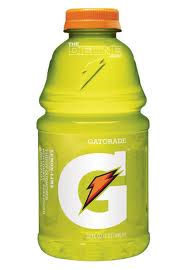
The reason I’m mad is that Gatorade has cornered the market on hydration stations at just about every half and full marathon I’ve been too; if it isn’t Gatorade, it’s the ugly step-brother Powerade. Both drinks are heavy on sweetness and hit my stomach like a round of buckshot. I’m not a huge fan of either and I generally don’t drink the stuff.  Unfortunately, I’m afraid that I am going to have to start.  They don’t hand out cups of Nuun or cups of my Honey-Water™ at races.

I think that one of the contributing factors to my physical breakdown in New York was due to last minute nutritional changes – that included switching to Gatorade mid-race when I realized that I was going to have to find an alternate source of carbohydrates when I was unable to stomach the banana flavored honey stingers I was trying for the first time.  Though I don’t blame Gatorade completely, I’m sure that my stressed system didn’t take to it too kindly.

So what’s the solution?

Unless I can come up with a better plan, I am going to have to train my body to accept Gatorade.  Plain old water is not a practical choice.  When I run for distance, I sweat like a LeBron James before a Celtics game.  I need the nutrients and minerals that water alone can’t replace.

Honestly, it would be nice to not have to carry anything in a long race other than a few Gu’s or Honey Stingers (just not that damned banana flavor though!), but I wonder if Gatorade is really the answer.

What’s your hydration strategy at the half- and full-marathon distances?

Bookmark and Share

Why do you run?

Read Full Post »

« Newer Posts - Older Posts »